

Finding out that your baby is in a breech position can raise lots of questions, particularly as your due date approaches.
You may be wondering whether your baby will turn naturally, whether there is anything you can do to encourage movement and what options are available if your baby remains breech.
You may also have come across the Webster Technique while researching pregnancy chiropractic care.
At Bump & Beyond Clinic in Wimbledon, we believe expectant parents deserve clear information about their options, without pressure or unrealistic promises.
This page explains what breech presentation means, what the Webster Technique involves and how chiropractic care fits alongside established maternity services.
If you are considering pregnancy chiropractic care, contact Bump & Beyond Clinic to discuss your circumstances and whether an appointment is appropriate.
During pregnancy, babies move and change position as they grow.
A baby is described as breech when their bottom or feet, rather than their head, are positioned to come out first.
There are several types of breech presentation.
The baby’s bottom is positioned downwards, with their legs extended upwards towards their head.
The baby is positioned bottom-first, with their hips and knees bent.
One or both feet are positioned below the bottom, meaning a foot may present first.
Your maternity team can explain your baby’s particular position and what it means for your pregnancy and birth planning.
Babies frequently change position during pregnancy. Many turn head-down as pregnancy progresses, but some remain breech.
In many cases, there is no clear reason why a baby remains in this position.
Factors that can be relevant include the stage of pregnancy, the amount of amniotic fluid, the position of the placenta, uterine shape and whether this is a multiple pregnancy.
A breech position does not automatically mean that anything is wrong with your baby or your body.
Your midwife or obstetrician can assess your circumstances and discuss whether further checks or planning are needed.
Breech presentation is particularly relevant when discussing birth planning later in pregnancy.
Your maternity team will usually check your baby’s position as your pregnancy progresses. If your baby remains breech towards the end of pregnancy, they can explain the available options and help you make an informed decision.
Depending on your circumstances, these options may include:
Waiting for the baby to turn spontaneously, where appropriate.
External cephalic version, commonly called ECV.
Planning a caesarean birth.
Considering a planned vaginal breech birth where appropriate and available.
The right option depends on your individual pregnancy, the baby’s position, your preferences and the clinical advice of your maternity team.
If you have been told that your baby is breech, speak to your midwife or obstetrician about your options and the timing of any recommended assessment.
The Webster Technique is a specific chiropractic analysis and care approach used during pregnancy.
It focuses on the relationship between the pelvis, surrounding muscles and ligaments, with the aim of addressing musculoskeletal tension and improving pelvic function.
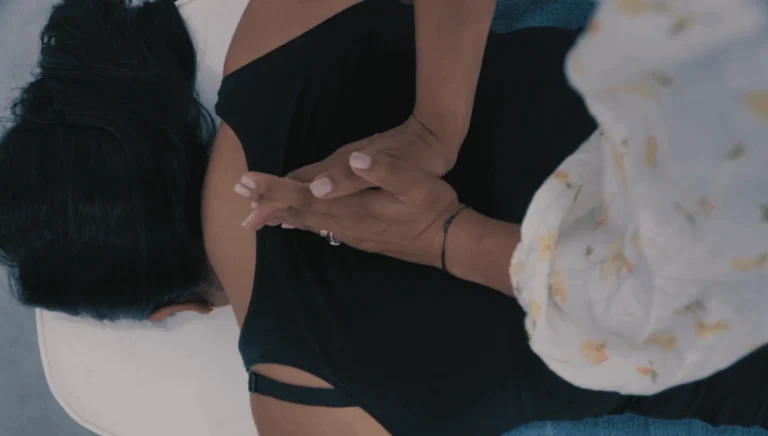
A practitioner trained in the technique may assess relevant pelvic and lower back structures and, where appropriate, use adapted manual techniques.
The approach is intended to address the pregnant woman’s musculoskeletal presentation. It is not an obstetric procedure and does not involve manually turning the baby.
At Bump & Beyond Clinic, the Webster Technique forms part of our pregnancy chiropractic offering. Its suitability depends on your individual circumstances and should be discussed with a qualified practitioner.
No. The Webster Technique is not a technique for manually turning a breech baby, and it cannot guarantee that a baby will move into a head-down position.
The technique focuses on the pregnant woman’s pelvic and musculoskeletal function. Some practitioners suggest that reducing musculoskeletal tension may create conditions that are more comfortable for the mother, but there is insufficient high-quality evidence to establish that the Webster Technique turns breech babies or reliably changes fetal position.
A baby may turn spontaneously as pregnancy progresses, but it is not possible to attribute a change in position to chiropractic treatment without appropriate evidence.
If your baby is breech, do not delay maternity assessment or recommended treatment while trying complementary approaches.
External cephalic version is a procedure offered by trained maternity professionals in appropriate circumstances to try to turn a baby from a breech position into a head-down position.
It is generally considered towards the end of pregnancy, often around 36 to 37 weeks, depending on individual circumstances and local maternity guidance.
During ECV, a trained clinician applies controlled pressure to the mother’s abdomen to attempt to change the baby’s position. The procedure is carried out in a clinical setting where the baby’s wellbeing can be monitored.
ECV is different from the Webster Technique.
Your maternity team can explain whether ECV is suitable for you, its potential benefits and risks, and what alternatives may be available.
Some pregnant women choose chiropractic care to help manage musculoskeletal discomfort as their bodies adapt to pregnancy.
If you are considering the Webster Technique while your baby is breech, the most important considerations are that:
Your maternity team remains responsible for assessing your baby’s position and advising on birth planning.
Chiropractic care should be directed towards appropriate maternal musculoskeletal concerns.
The technique should not be represented as a proven way to turn a baby.
Treatment should be adapted to your pregnancy, symptoms and medical history.
Complementary treatment should never delay recommended maternity care.
At Bump & Beyond Clinic, we encourage open communication about your pregnancy and any advice you have received from your midwife or obstetrician.
If you enquire about the Webster Technique, your appointment should begin with a discussion about your pregnancy, symptoms and expectations.
This may include:
Your practitioner will discuss your stage of pregnancy, relevant medical history and any musculoskeletal symptoms you are experiencing.
Where appropriate, an assessment may consider pelvic and lower back movement and the surrounding soft tissues.
If treatment is suitable, techniques will be adapted to your comfort and stage of pregnancy.
If your main concern is breech presentation, your practitioner should explain the limitations of the Webster Technique and direct you to your maternity team for advice about fetal position and birth planning.
You should feel able to ask questions and make decisions without pressure.
If you have been told that your baby is breech, contact your midwife or obstetrician to discuss the recommended checks and available options.
Seek urgent maternity advice if you experience vaginal bleeding, fluid leaking, reduced or changed fetal movements, or other symptoms that concern you.
If you think your waters have broken while your baby is breech, contact your maternity unit immediately because breech presentation can affect the risks associated with labour and cord prolapse.
Call 999 if you believe there is an immediate emergency, including a visible or felt umbilical cord after your waters break.
Do not rely on chiropractic care or online advice to assess a breech pregnancy.
At Bump & Beyond Clinic, we support expectant mothers with individualised pregnancy chiropractic care, including the Webster Technique where appropriate.
We understand that discovering your baby is breech can feel worrying, especially when you are trying to understand the options available to you.
Our role is to explain what our care involves, answer your questions about the technique and help you understand how it may fit alongside your maternity care.
We are based at 174 Merton High Street, Wimbledon, SW19 1AY, and welcome enquiries from expectant parents across South West London.
Call 07818 325009 or email info@bumpandbeyondclinic.co.uk to discuss a pregnancy chiropractic appointment.
No. The Webster Technique is a chiropractic approach focused on maternal pelvic and musculoskeletal function. It is not a procedure for manually turning a baby, and evidence does not establish that it reliably changes fetal position.
No. External cephalic version is a clinical procedure performed by trained maternity professionals to attempt to turn a breech baby. The Webster Technique is a chiropractic approach focused on the pregnant woman’s musculoskeletal function.
Discuss your baby’s position with your midwife or obstetrician, particularly as you approach the final weeks of pregnancy. They can explain the timing of assessment and the options available to you.
Whether chiropractic care is appropriate depends on your individual circumstances. Any treatment should be directed towards suitable maternal musculoskeletal concerns and should not replace maternity assessment or birth planning.
Some babies turn into a head-down position as pregnancy progresses. However, it is not possible to predict exactly when or whether an individual baby will turn. Your maternity team can advise on monitoring and available options.
Bump & Beyond Clinic offers pregnancy chiropractic care, including the Webster Technique where appropriate. The clinic is located at 174 Merton High Street, Wimbledon, SW19 1AY. Call 07818 325009 to discuss your circumstances.